Brady Audit Log for Legal Teams: 2026 Guide
Discover what is a Brady audit log and its vital role in legal transparency. Ensure compliance and manage case files effectively in 2026.

Brady Audit Log for Legal Teams: 2026 Guide
A Brady audit log is a tamper-evident, append-only record that documents every meaningful action taken on case files, serving as the primary mechanism for legal transparency and ethical compliance in criminal defense practice. Legal professionals and compliance officers rely on this record to prove that discovery obligations were met, that evidence was not altered, and that every access event is traceable to a specific actor. Platforms like Caseflow have built Brady audit log functionality directly into their discovery workflows, making compliance tracking automatic rather than manual. Understanding what a Brady audit log is, how it differs from a generic audit trail, and what regulations govern it is no longer optional for defense teams managing complex case files.
What is a brady audit log and how does it work?
A Brady audit log is a specialized event record that captures the who, what, when, and where of every significant action performed on case files within a legal matter. Unlike a general server log, it is designed from the ground up for evidentiary and compliance purposes. Effective audit logs must record authentication events, permission changes, data exports, destructive actions, and sensitive data access to fulfill their compliance role.
The core value of a Brady audit log lies in three properties: immutability, non-repudiation, and tamper evidence. Immutability means no entry can be edited or deleted after it is written. Non-repudiation means the actor who performed an action cannot credibly deny it. Tamper evidence means any unauthorized modification to the log is detectable, often through cryptographic hash-chaining.

Hash-chaining works by embedding a hash of each log entry, plus the hash of the previous entry, into every new record. Hash-chaining cryptographically links each entry so that any alteration breaks the chain and is independently detectable. This matters in court because a broken chain is mathematical proof of interference, not just an allegation.
Typical actions captured in a Brady audit log include:
- File views: who opened a document and at what timestamp
- Edits and annotations: what changed, including the prior value and the new value
- Exports and downloads: when evidence left the platform and to which user account
- Deletions and restorations: whether a file was removed and by whom
- Approvals and sharing events: when a file was shared with opposing counsel or the court
Pro Tip: Configure your audit log to record “skipped” or missed actions, not just completed ones. Capturing skipped events explains omissions in case file processing and is critical for thorough forensic reconstruction during litigation.
How do brady audit logs differ from audit trails?
The terms “audit log” and “audit trail” are used interchangeably in most offices, but regulators treat them as distinct concepts with different legal weight. An audit log is the raw event data: a time-stamped stream of records written as actions occur. An audit trail is a curated, tamper-evident reconstruction of those events, organized to answer a specific compliance or forensic question.
SOX §404, HIPAA §164.312(b), and FDA 21 CFR Part 11 each distinguish between audit trail requirements and basic audit log requirements. Regulators demand audit trails because they are reconstructable and verifiable, not just present. A Brady audit log serves as the raw foundation from which a defensible audit trail is built.
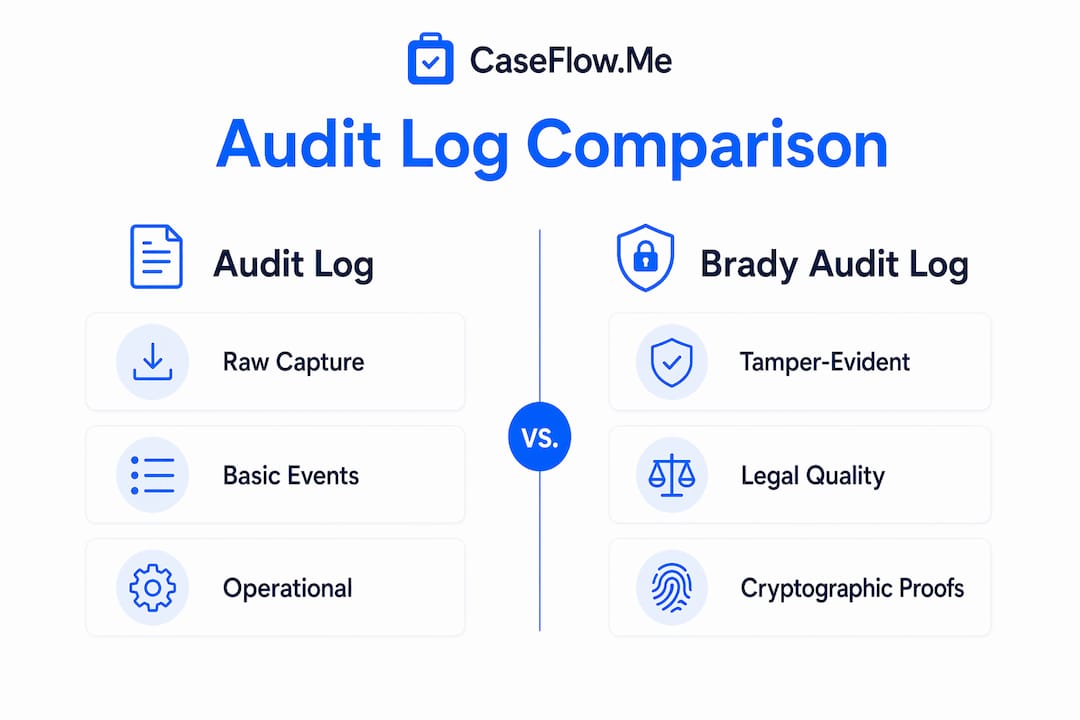
The table below summarizes the key differences:
| Feature | Audit Log | Audit Trail | Brady Audit Log |
|---|---|---|---|
| Purpose | Raw event capture | Compliance reconstruction | Evidentiary and ethics compliance |
| Tamper evidence | Optional | Required | Required (hash-chaining preferred) |
| Admissibility | Limited | High | High when cryptographically secured |
| Retention mandate | Varies | 7+ years (SOX, HIPAA) | Governed by case and regulatory rules |
| Primary user | IT and developers | Auditors and regulators | Defense attorneys and compliance officers |
Brady audit logs must be differentiated from application logs and operational logs that developers use mainly for debugging. Only audit logs designed for evidentiary purposes serve legal teams in court or regulatory proceedings.
Why brady audit log requirements matter in 2026
The regulatory environment governing audit logs has tightened significantly. SOX §404, HIPAA §164.312(b), 21 CFR Part 11, and GDPR Article 30 all require organizations to maintain verifiable records of who accessed or modified sensitive data. Audit logs must often be kept for 7 or more years under defined retention and archival policies. That retention window means a case file action taken today may need to be reconstructable nearly a decade from now.
The financial stakes are concrete. Audit-trail gaps appear in 35% of analyzed data breach incidents, and the global average cost of a data breach is $4.88 million. For a law firm, a breach compounded by missing or incomplete audit records creates both regulatory liability and malpractice exposure.
Pro Tip: Separate your evidentiary audit logs from your operational logs at the architecture level. Legal teams require logs that are tamper-evident and have controlled retention. Mixing them with developer debug logs creates confusion and risks accidental deletion of compliance-critical records.
Courts are also raising the bar on authentication. The Federal Rules of Evidence increasingly require cryptographic proofs such as hash chains and digital signatures for audit log admissibility, replacing reliance on custodian testimony. This shift means a compliance officer who relies on a system administrator’s word in court is operating on a standard that judges are beginning to reject. Cryptographically verifiable logs shift the burden of proof away from witnesses and onto mathematics.
For criminal defense specifically, the Brady obligation requires prosecutors to disclose exculpatory evidence. A defense attorney who can demonstrate through an audit log that the prosecution accessed, modified, or withheld a specific file has a powerful evidentiary tool. The log is not just a compliance record. It is a litigation asset.
Best practices for implementing brady audit logs
Effective Brady audit log implementation starts with design, not configuration. The log table must be append-only: logs must not allow UPDATE or DELETE operations, and every record must capture state snapshots before and after each change. This old-value and new-value structure is what makes forensic reconstruction possible.
Follow these implementation steps to build a defensible Brady audit log:
- Define the event taxonomy. List every action type your platform must log: file views, edits, exports, deletions, approvals, and sharing events. Undefined events become gaps.
- Enforce append-only storage. Use database-level constraints or write-once object storage to prevent modification or deletion of log entries.
- Implement hash-chaining. Each entry should contain a hash of its own content plus the hash of the prior entry. This creates the tamper-evident chain regulators and courts expect.
- Denormalize actor identity. Store the actor’s name, role, and identifier directly in the log entry. Do not rely on a foreign key to a user table that could change or be deleted later.
- Set automated retention and archiving policies. Define how long logs are kept, where they are archived, and who controls access to archived records. Align these policies with SOX, HIPAA, and any applicable state bar rules.
- Separate evidentiary logs from operational logs. Keep Brady audit logs in a dedicated, access-controlled store. Do not co-locate them with application error logs or performance metrics.
- Test the chain regularly. Run automated verification of your hash chain on a scheduled basis. A broken chain discovered during a routine check is far better than one discovered during cross-examination.
Platforms like Caseflow handle many of these steps automatically through their discovery action tracking features, reducing the engineering burden on legal teams that lack dedicated IT infrastructure.
How to interpret brady audit log data for legal insights
Raw audit log data is only useful if you know what to look for. The most valuable analysis technique is the old-value and new-value comparison. Tracking old and new value states for all changes enables comprehensive root cause analysis and forensic audits, which are central to defense litigation strategy.
When reviewing a Brady audit log for compliance or litigation purposes, focus on these patterns:
- Access clustering: Multiple views of the same file by the same actor in a short window may indicate preparation for disclosure or concealment.
- Deletion events without corresponding restoration: A deleted file with no restoration record raises immediate questions about evidence preservation.
- Export events near key deadlines: Downloads occurring just before a discovery deadline or hearing date warrant scrutiny.
- Skipped or missing sequence numbers: Gaps in sequential log entries suggest records may have been removed, which breaks the hash chain if cryptographic logging is in place.
- Permission escalations: An actor gaining elevated access immediately before a sensitive file is modified is a red flag in any forensic review.
Cross-referencing audit log data with other compliance documentation strengthens any investigation. For example, comparing a Brady audit log entry showing a file export with the corresponding email records or court filing timestamps can confirm or contradict a party’s account of events. Defense teams using automated discovery workflows can surface these cross-references faster than manual review allows.
The legal compliance audit log types you maintain also determine what forensic questions you can answer. A log that captures only file opens but not exports cannot prove whether evidence left the system. Completeness is not a technical nicety. It is a legal requirement.
Key takeaways
A Brady audit log is the foundational evidentiary record that makes legal transparency provable, not just claimable, and its integrity depends on cryptographic design, not policy alone.
| Point | Details |
|---|---|
| Brady audit log definition | An append-only, tamper-evident record of every significant action on case files, built for evidentiary and compliance use. |
| Cryptographic integrity is required | Hash-chaining makes tampering independently detectable, meeting Federal Rules of Evidence admissibility standards. |
| Audit logs differ from audit trails | Audit logs are raw event data; audit trails are curated reconstructions. Regulators require the latter for SOX, HIPAA, and FDA compliance. |
| Retention spans years, not months | SOX, HIPAA, and GDPR mandate 7 or more years of retention, requiring defined archiving policies from day one. |
| Completeness determines legal value | Logs that miss exports, deletions, or skipped actions cannot support full forensic reconstruction in litigation. |
Why most legal teams are still getting this wrong
I have reviewed compliance setups at firms that believed they were fully covered because their case management software had an “activity log.” In nearly every case, that log was an operational record, not an evidentiary one. It had no hash-chaining, no old-value and new-value capture, and no defined retention policy. It was, legally speaking, almost worthless.
The shift toward cryptographic proofs is the single most important development in legal audit log practice in the past decade. Relying on a system administrator to testify that a log was not altered is a losing strategy. Courts are moving toward mathematical verification, and the firms that understand this now will have a structural advantage in any dispute involving case file integrity.
My advice to compliance officers is to treat the Brady audit log as a first-class legal document, not a byproduct of your software. Define your event taxonomy before you configure your platform. Verify your hash chain on a schedule. And separate your evidentiary logs from your IT team’s debug logs before those two categories get confused in a production incident.
The future of this space is automated, cryptographically verifiable, and integrated directly into discovery workflows. Firms that wait for a court order to upgrade their logging practices will find themselves explaining gaps under oath.
— Faisal
How Caseflow handles brady audit logging automatically
Caseflow builds tamper-evident Brady audit logging directly into its criminal defense discovery platform, so compliance is not a separate project. Every action on a case file, from the first file view to the final export, is recorded in an append-only log with cryptographic integrity built in.
Caseflow’s security architecture supports the hash-chained audit trail standards that courts and regulators now expect, without requiring your team to configure anything manually. The platform also integrates audit log data with its transcription, summarization, and entity extraction features, giving defense attorneys a single source of truth for both case content and compliance history. If your firm needs a discovery platform that treats audit integrity as a core feature rather than an afterthought, explore Caseflow’s full capabilities to see how it fits your workflow.
FAQ
What is a brady audit log in criminal defense?
A Brady audit log is a tamper-evident, append-only record of every significant action taken on case files, designed to document compliance with discovery obligations and support evidentiary transparency in criminal defense proceedings.
How does a brady audit log differ from a regular audit trail?
An audit log captures raw event data as actions occur, while an audit trail is a curated, tamper-evident reconstruction used for compliance and court purposes. Regulations like SOX §404 and HIPAA §164.312(b) specifically require audit trails, not just raw logs.
What are the brady audit log requirements under federal rules?
The Federal Rules of Evidence increasingly require cryptographic proofs such as hash chains and digital signatures for audit log admissibility, replacing custodian testimony as the primary authentication method.
How long must brady audit logs be retained?
SOX, HIPAA, and GDPR mandate audit log retention of 7 or more years, requiring defined archiving and access-control policies from the moment logs are created.
Why do brady audit logs matter for compliance officers?
Audit-trail gaps appear in 35% of analyzed data breach incidents, and the global average breach cost is $4.88 million. Incomplete or non-cryptographic logs expose firms to both regulatory penalties and litigation liability.
Recommended
Procedural content for defense attorneys — not legal advice in your jurisdiction.
Start free trial · $100 credit