How to Create a Defensible Discovery Audit Trail
Learn how to create a defensible discovery audit trail with verifiable records. Ensure your case materials meet authentication standards effectively!

How to Create a Defensible Discovery Audit Trail
A defensible discovery audit trail is a verifiable, tamper-proof record of every action taken on case materials during the discovery process, designed to satisfy authentication standards under Federal Rule of Evidence 901. For criminal defense attorneys, this record is not a formality. It is the evidentiary backbone that proves your discovery process was lawful, complete, and untampered. Tools like Caseflow, TrueScreen, and DeepInspect now make it possible to create defensible discovery audit trails that capture identity, timestamps, cryptographic signatures, and AI decision logs in a single workflow. This guide walks you through every step, from prerequisites to advanced AI-specific strategies.
What does it take to create a defensible discovery audit trail?
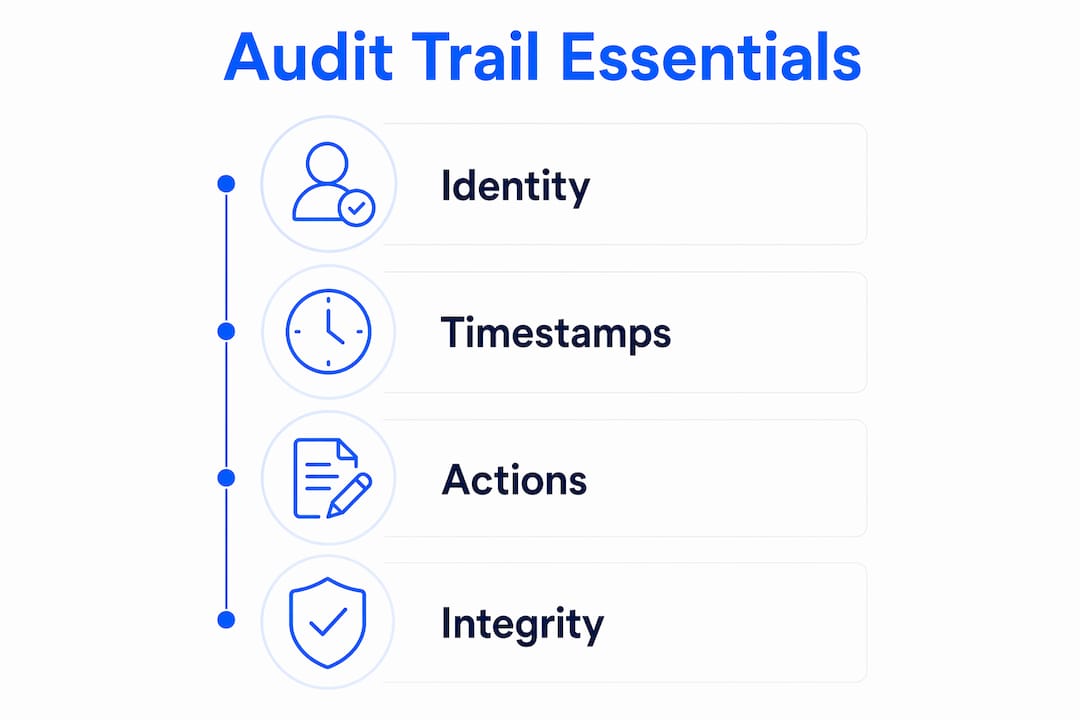
A defensible audit trail captures four non-negotiable elements: identity, timestamps, actions, and cryptographic integrity. Miss any one of them and the record will not survive an FRE 901 authentication challenge. Courts apply a preponderance of evidence standard, meaning your documentation must make it more likely than not that the record is genuine and unaltered.
Core components every audit trail must include
Before you configure any software, confirm your audit trail captures the following:
- Identity: Who accessed, reviewed, or modified each file, recorded at the user account level, not just the role level.
- Timestamps: Precise date and time for every action, ideally synchronized to a trusted time authority.
- Action type: What was done, whether that is opening, annotating, exporting, or flagging a document.
- Cryptographic signature: A per-record hash that allows independent verification without reconstructing the entire log.
- Chain of custody marker: When and how each item entered the secured repository.
Behavioral evidence logs are more reliable than role-based assumptions for custodian identification. Logging that “the administrator role accessed file X” is far weaker than logging that “user jsmith@defensefirm.com accessed file X at 14:32:07 UTC.” That specificity is what narrows custodian lists and reduces overcollection risk.
Forensic certification platforms worth knowing

Platforms like TrueScreen apply ISO/IEC 27037 standards with cryptographic sealing and qualified timestamps, embedding authenticity at the moment of data creation. DeepInspect focuses on AI-assisted review workflows and provides per-request audit records. Caseflow’s Brady-trail audit log tracks every action taken on case files within its platform, giving defense teams a ready-made compliance record. The right platform depends on your workflow, but all three demonstrate that certified forensic acquisition eliminates dependence on reconstructive chain of custody arguments after the fact.
Policy and training prerequisites
Technology alone does not produce a defensible record. Your team needs a written policy that defines who can access discovery materials, under what conditions, and how deviations are reported. Train every paralegal, associate, and investigator on the policy before a single file is opened. Courts have rejected audit trails not because the logs were technically flawed, but because no one could explain the firm’s access control procedures.
How to build and maintain your audit trail step by step
The discovery lifecycle runs from collection through production. Your audit trail must cover every stage without gaps.
-
Establish a secured repository at obligation onset. The Collect-to-Preserve practice means pulling relevant cloud collaboration data into a secured environment the moment a preservation obligation arises. This prevents reliance on in-place retention and establishes a clear custody start point.
-
Capture identity and access logs for every discovery action. Configure your platform to record the authenticated user identity, not just the session token, for each file interaction. If your firm uses single sign-on through Microsoft Entra ID or Okta, confirm those identity assertions flow into the audit log.
-
Record AI model settings and prompt chains if you use AI-assisted review. This step is where most teams fall short. Every AI review request must log the identity of the requesting attorney, the exact prompt submitted, the model version, and the output received. Skipping this creates an unexplained gap in your decision record.
-
Implement append-only, cryptographically signed logs. HMAC-SHA256 signatures applied per record allow any single entry to be independently verified without traversing the entire ledger. This is the technical standard that transforms a log file into a portable evidentiary package.
-
Document chain of custody from collection to production. Every transfer, format conversion, and redaction must appear in the record. Note the date, the responsible party, the tool used, and the resulting file hash.
-
Run periodic verification audits. Do not wait for opposing counsel to challenge your records. Schedule monthly spot checks where a team member independently verifies a random sample of log entries against the underlying files.
-
Export in court-ready format before production. Most platforms support PDF or CSV exports of audit logs. Caseflow’s Brady-trail log exports directly alongside case materials, so the evidentiary record travels with the production set.
Pro Tip: Set up automated alerts for any log entry that lacks a cryptographic signature. A missing signature is a silent failure. You will not catch it during production unless you build detection into the workflow.
What are the most common audit trail mistakes in discovery?
Most audit trail failures are not dramatic. They are quiet omissions that only surface when opposing counsel files a motion to suppress or a judge asks for authentication evidence.
Relying on role-based access records
Role-based logs record that “an admin” performed an action. Behavioral evidence logs record that a specific authenticated individual performed that action. Courts applying FRE 901 want to know who, not what category of user. Swap role-based assumptions for individual identity assertions as soon as possible.
Incomplete AI prompt logging
“Most teams overlook preserving full AI decision context: identity, exact prompts, model version and configuration, and intermediate mutations are critical to explain outputs in contested cases.” — Audit Trails for AI Outputs
If you used an AI tool to flag responsive documents and you cannot produce the prompt that generated those flags, you cannot defend the responsiveness determination. This gap has already surfaced in federal civil litigation and will reach criminal discovery disputes as AI adoption grows.
Missing cryptographic signatures
A log without per-record signatures is just a text file. Any party with write access could alter it. Independent record verification using cryptographic append-only receipts is the only method that makes tampering detectable without relying on the custodian’s word.
Stripping context from raw logs
Raw logs list events. Defensible records explain them. An audit trail’s evidentiary value increases significantly when accompanied by a plain-English narrative explaining AI usage, safeguards applied, and the boundaries of human judgment in the review process. Judges and regulators are not log analysts. Give them a document they can read.
To learn more about the types of compliance audit logs that apply to criminal defense discovery, review the full breakdown of log categories and their legal functions.
Advanced strategies: AI-assisted discovery and cryptographic validation
AI-assisted discovery is now standard practice in federal criminal cases involving large document sets. The audit trail requirements that come with it are more demanding than those for manual review, not less.
Recording AI review requests with full evidentiary detail
Defensible AI audit trails must record identity, prompt chains, policy versions, mutations, and outputs per review request. That means every time an attorney submits a query to an AI review tool, the system must capture the following:
| Element | What to record | Why it matters |
|---|---|---|
| Requesting identity | Authenticated user ID and timestamp | Establishes who directed the AI review |
| Prompt submitted | Full text of the query | Explains the scope of the AI’s analysis |
| Model version | Software version and configuration | Allows reproduction and challenge response |
| Policy settings | Active filters, privilege rules, language settings | Documents the review parameters |
| Output received | Document list, summaries, or flags generated | Ties the AI decision to a specific input |
| Intermediate mutations | Any prompt revisions during the session | Captures the full decision chain |
Capturing all prompt iterations and configuration changes explains output variations and defends privilege and responsiveness arguments. Without this table of records, you are asking a court to trust a black box.
Using append-only ledgers with HMAC-SHA256 signatures
The technical standard for tamper-evident logs is an append-only ledger where each entry carries an HMAC-SHA256 signature generated with an isolated signing key. This architecture means that altering any record breaks its signature, and the break is detectable without access to the original signing key. DeepInspect implements this model natively. Caseflow’s Brady-trail log applies the same principle to case file actions, giving defense teams a court-ready integrity record.
Pro Tip: Store your signing keys in a hardware security module or a dedicated key management service like AWS KMS or Azure Key Vault. A signing key stored in the same system as the logs it protects offers no real tamper protection.
Building a complete evidence packet for court submission
An evidence packet for AI-assisted discovery should include the raw log export, the cryptographic verification report, the plain-English narrative of AI usage, and the policy document in effect at the time of review. Audit trails for AI outputs gain utility for courts when technical completeness is paired with readability. Prepare this packet before production, not after a challenge is filed.
For a deeper look at how technology shapes criminal defense discovery, including authentication requirements specific to AI tools, the linked resource covers the full scope.
Key takeaways
A defensible discovery audit trail requires identity-level logging, cryptographic signatures, and complete AI decision records to survive FRE 901 authentication challenges.
| Point | Details |
|---|---|
| Identity over role | Log authenticated user IDs, not role categories, for every discovery action. |
| Cryptographic integrity | Apply HMAC-SHA256 per-record signatures to make tampering independently detectable. |
| AI prompt logging | Record every prompt, model version, and output for each AI-assisted review request. |
| Collect-to-Preserve | Pull materials into a secured repository at obligation onset to establish clear chain of custody. |
| Plain-English narrative | Pair technical logs with a readable explanation of AI usage and human judgment boundaries. |
Why I think most defense teams are one motion away from a problem
I have reviewed discovery workflows at firms that considered themselves technically current. The gap I see most often is not in the logging software. It is in the assumption that logging is happening correctly because no one has complained yet. A log that records role-based access instead of individual identity, or an AI review session with no prompt record, looks fine until opposing counsel asks a pointed question at a suppression hearing.
The shift to AI-assisted discovery has made this worse, not better. Attorneys are using AI tools to process thousands of documents in hours, which is genuinely useful. But the audit trail requirements for AI review are stricter than for manual review because the decision logic is less transparent. A human reviewer can testify about their thought process. An AI model cannot. The log is the only witness.
My practical advice is to treat the audit trail as a first-class deliverable, not a byproduct of your review platform. Build the evidence packet before production. Run verification checks monthly. And invest in a platform that applies cryptographic signatures at the record level, not just at the export level. The difference between a log and a defensible record is exactly that level of specificity.
The firms that will handle discovery challenges well in the next few years are the ones building this infrastructure now, before a judge asks for it under pressure.
— Faisal
How Caseflow automates defensible audit trail creation
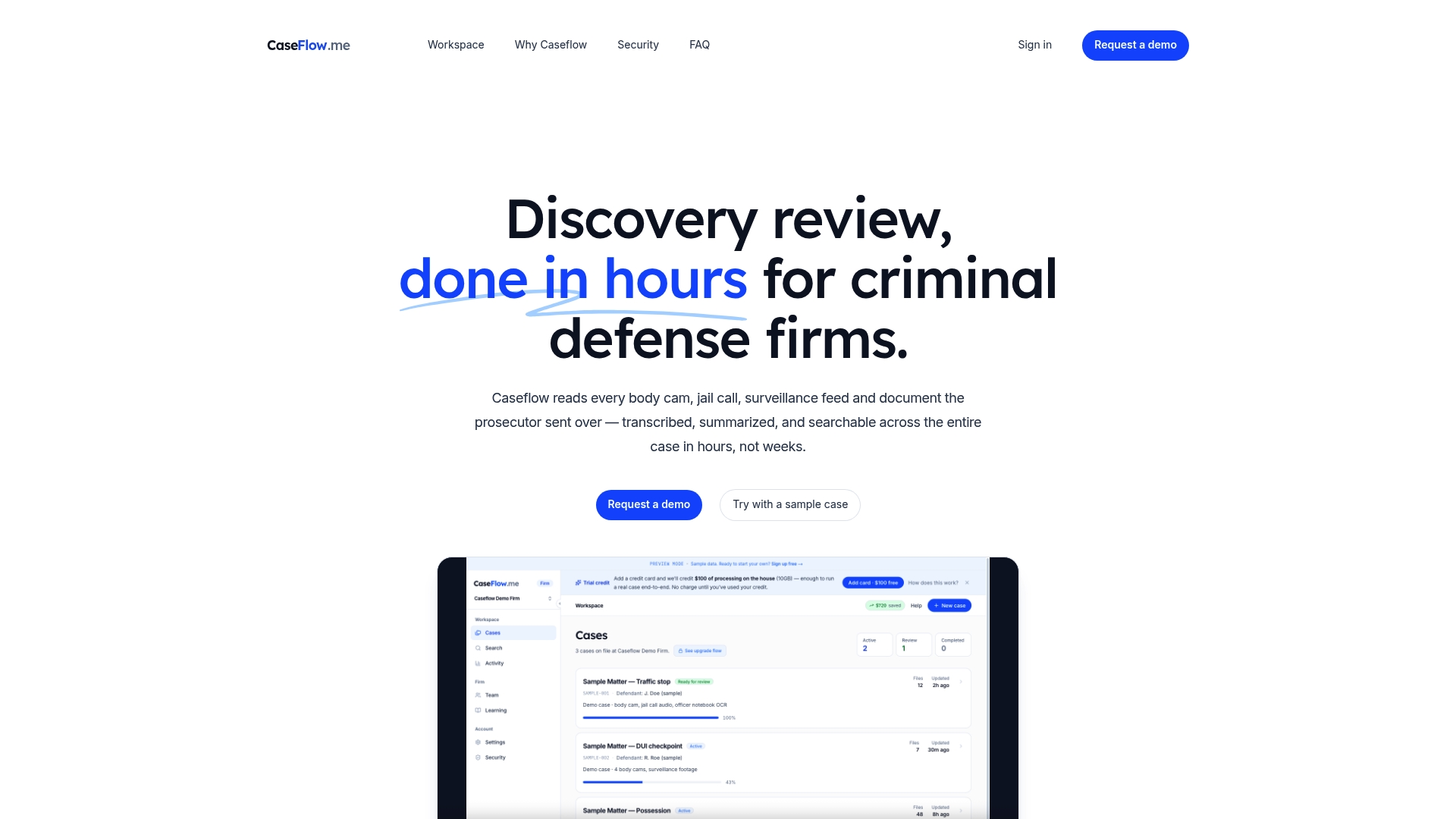
Caseflow is built specifically for criminal defense teams that need a court-ready discovery record without adding hours of manual documentation. The platform’s Brady-trail audit log tracks every action taken on case files, recording identity, timestamps, and actions in an append-only format that meets compliance standards. Caseflow combines transcription, summarization, and searchable entity extraction in one platform, so your audit trail covers every stage of the discovery lifecycle. It supports multiple languages and preserves original audio for accuracy. If your team is ready to move from manual logging to automated, defensible discovery compliance, Caseflow is the place to start.
FAQ
What is a defensible discovery audit trail?
A defensible discovery audit trail is a tamper-proof, chronological record of all actions taken on discovery materials, capturing identity, timestamps, actions, and cryptographic integrity to satisfy FRE 901 authentication standards.
Why are cryptographic signatures required for audit trail compliance?
Cryptographic signatures applied per record allow any entry to be independently verified without reconstructing the entire log, making tampering detectable and the record legally reliable.
What must AI-assisted discovery audit trails include?
AI-assisted discovery audit trails must record the requesting identity, the exact prompt submitted, the model version and configuration, policy settings, and all outputs received for each review request.
How does FRE 901 apply to discovery audit trails?
FRE 901 requires evidence sufficient to prove an item is what it claims, using a preponderance of evidence standard, which means your audit trail must document who, what, when, and how with verifiable integrity metadata.
How do I protect my audit trail from tampering?
Use an append-only ledger with HMAC-SHA256 per-record signatures and store signing keys in an isolated key management service, separate from the system that holds the logs.
Recommended
Procedural content for defense attorneys — not legal advice in your jurisdiction.
Start free trial · $100 credit