The Role of Searchable Discovery Tools in Legal Cases
Discover the essential role of searchable discovery tools in legal cases. Learn how they enhance efficiency and improve outcomes for attorneys.

The Role of Searchable Discovery Tools in Legal Cases
Searchable discovery tools are defined as software systems that index, retrieve, and synthesize case evidence through keyword and AI-powered semantic search. The role of searchable discovery tools in legal practice has shifted from a convenience to a core operational requirement. Criminal defense attorneys who still rely on manual document review face a measurable disadvantage: sifting through case files can take weeks, while platforms like Caseflow reduce that time to hours. This article explains how these tools work, what they deliver, and where they fall short.
How do searchable discovery tools work to improve case management?
Modern discovery platforms use hybrid search architectures that combine keyword indexing with semantic models to handle large, unstructured legal datasets. Keyword indexing matches exact terms, statute numbers, or case identifiers with deterministic precision. Semantic models interpret meaning, so a search for “defendant’s location” also surfaces documents mentioning “whereabouts” or “GPS data.” Together, these two layers cover what neither approach can handle alone.
The technical workflow follows a clear sequence:
- Ingestion. Documents, audio files, and transcripts are uploaded and converted into machine-readable text through automated transcription.
- Indexing. The platform extracts metadata, entities (names, dates, locations), and full text, then builds a search index optimized for speed.
- Query processing. When an attorney searches, the system runs the query against both the keyword index and the semantic vector space simultaneously.
- Ranking and retrieval. Results are ranked by relevance, with filters available by document type, date range, speaker, or entity.
- Synthesis. AI summarization condenses long transcripts or document sets into key findings, reducing the time attorneys spend reading raw evidence.
Features like fuzzy matching and synonym handling mean a search for “firearm” also returns “weapon,” “gun,” and “pistol” without requiring separate queries. Real-time indexing makes new evidence searchable seconds after ingestion, which matters when prosecutors produce late discovery disclosures.
Pro Tip: Set up entity extraction filters for names and locations before you run your first search. Filtering by named entity type cuts result sets dramatically and surfaces the most relevant documents faster than keyword search alone.

The difference between a basic search bar and a true automated discovery system is the automation layer. Basic search finds what you ask for. Discovery tools find what you did not know to ask for.
What are the key benefits and impacts of using searchable discovery tools?
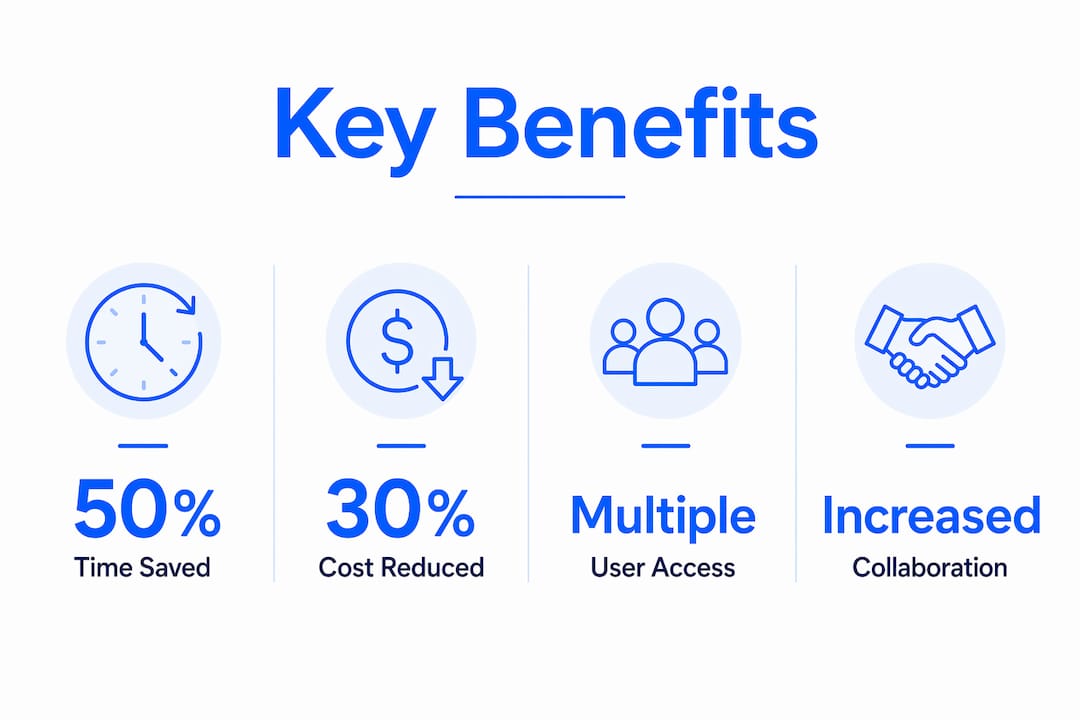
The importance of discovery tools becomes clearest when you measure time. Caseflow reports reducing discovery review from weeks to hours. That compression directly affects case preparation quality, not just billing efficiency.
The documented benefits fall into four categories:
- Time reduction. AI-powered knowledge tools reduce support ticket ratios by up to 27% by replacing manual document scanning with instant retrieval. The same principle applies in legal discovery: fewer hours spent searching means more hours spent building arguments.
- Accuracy gains. Automated metadata extraction and semantic relevance ranking surface documents that keyword search alone would miss. An attorney searching for alibi evidence may not know which specific terms appear in a surveillance log.
- Hidden connections. New discovery methods dramatically increase the likelihood of identifying critical but previously unobservable connections in evidence. A platform that links a witness name across 200 documents in seconds would take a paralegal days to replicate manually.
- Workflow transparency. Platforms with audit logs record every search, every document opened, and every action taken. That record supports defensible discovery in court and satisfies Brady compliance requirements.
The searchable database benefits extend to collaboration as well. Multi-user access controls let attorneys, paralegals, and investigators work on the same case file simultaneously without version conflicts. Role-based permissions prevent junior staff from accessing sealed materials or privileged communications.
The impact of searchable tools on cost is direct. Fewer billable hours spent on document review translates to lower costs for clients and higher margins for firms. For criminal defense attorneys handling high-volume public defender caseloads, that efficiency is not optional.
Keyword search vs. AI semantic search: which approach wins?
The answer is neither alone. Hybrid discovery environments allow attorneys to switch fluidly between precise keyword search and AI-powered synthesis for optimal results. Understanding when to use each approach prevents costly errors.
| Feature | Keyword search | AI semantic search |
|---|---|---|
| Best use case | Exact statute citations, names, dates | Conceptual queries, theme exploration |
| Strength | Deterministic, auditable, fast | Surfaces related concepts and synonyms |
| Weakness | Misses synonyms and paraphrased content | Can prioritize similar evidence over contradictory evidence |
| Legal risk | Under-retrieval if terms vary | Over-retrieval with false positives |
| Audit defensibility | High, results are reproducible | Lower without explicit filter documentation |
Keyword search remains superior for exact match queries and metadata filtering essential for legal accuracy. When you need every document mentioning a specific case number or statute, keyword search delivers a complete, reproducible result set.
Semantic search excels at synthesis. Ask it to find all documents related to the defendant’s mental state, and it will surface psychiatric evaluations, witness statements about behavior, and medical records without requiring you to list every possible term. That capability is genuinely new in legal discovery.
The critical risk with semantic search is that it prioritizes similarity and can hide contradictory evidence by burying documents that diverge from the query’s implied direction. A search for evidence supporting self-defense may rank documents confirming that narrative higher than documents that undermine it. That is a serious problem in criminal defense, where contradictory evidence must be reviewed and addressed.
Pro Tip: After every semantic search, run a keyword search using the same core terms and compare the result sets. Documents that appear in one but not the other often contain the most legally significant material.
The roles of information retrieval tools in legal practice are defined by this tension. Precision and recall are both required. No single search paradigm delivers both without the other as a check.
What governance and data integrity considerations must legal teams address?
Discovery tools that lack governance controls are a liability, not an asset. Access control is a fundamental requirement for any discovery platform, balancing discoverability with confidentiality and compliance.
The governance requirements for legal teams using these platforms include:
- Source-of-truth separation. Best practice separates the original evidence database from the search index. The source database remains immutable. The search engine reads from it but never writes to it. This architecture prevents accidental data modification and preserves chain of custody.
- Role-based access control. Not every team member needs access to every document. Platforms must enforce permissions at the document level, not just the case level. Caseflow’s Brady-trail audit log tracks every action taken on case files, which satisfies both internal compliance and court disclosure requirements.
- Audit trail defensibility. Every search query, document view, and export must be logged with a timestamp and user ID. A defensible audit trail protects attorneys from spoliation claims and supports Brady material documentation.
- Multi-language evidence handling. Cases involving non-English speakers require platforms that process evidence in the original language while preserving the source audio. Altering or mistranslating evidence during processing creates both ethical and evidentiary problems.
- Data synchronization. When new evidence is added to the source database, the search index must update automatically. Stale indexes cause attorneys to miss recently produced documents, which is a compliance failure in jurisdictions with ongoing disclosure obligations.
Effective discovery integrates layered systems that allow moving fluidly between synthesis and precision. Governance is what makes that movement trustworthy. Without it, speed becomes a risk rather than an advantage.
Key Takeaways
Searchable discovery tools deliver their full value only when hybrid search, governance controls, and audit-ready architecture operate together in a single platform.
| Point | Details |
|---|---|
| Hybrid search is required | Keyword and semantic search each cover gaps the other misses; use both on every case. |
| AI reduces review time | Platforms like Caseflow cut discovery review from weeks to hours through automated indexing. |
| Semantic search carries risk | AI similarity ranking can suppress contradictory evidence; always cross-check with keyword results. |
| Governance protects the case | Immutable source databases, role-based access, and audit logs are non-negotiable for compliance. |
| Audit trails support Brady compliance | Logged actions on every case file document demonstrate disclosure obligations were met. |
Why I think most firms are using these tools wrong
Attorneys adopt discovery platforms and immediately run semantic searches because the results feel impressive. The tool surfaces 40 relevant documents in seconds, and the instinct is to trust that completeness. That instinct is wrong.
Semantic search is an exploration tool, not a retrieval tool. It tells you what territory exists. Keyword search tells you exactly what is in that territory. Treating semantic results as a final answer is the most common and most dangerous mistake I see in legal tech adoption.
The second mistake is treating the search index as the record of truth. Search engines are optimized for relevance and speed but cannot replace immutable databases that serve as the source of truth. Attorneys who export from the index without verifying against the source database are building arguments on a foundation that could shift.
The firms that get this right treat discovery tools as a two-stage process. Stage one is exploration with semantic search and entity extraction. Stage two is verification with keyword search and source database confirmation. That sequence is slower than pure AI search, but it is defensible. And in criminal defense, defensibility is everything.
When evaluating a platform, ask one question before any other: where does the original evidence live, and can the search tool modify it? If the answer is unclear, the platform is not ready for legal use.
— Faisal
Caseflow’s approach to AI-powered legal discovery
Criminal defense attorneys who need faster, more accurate discovery review have a direct path forward with Caseflow.
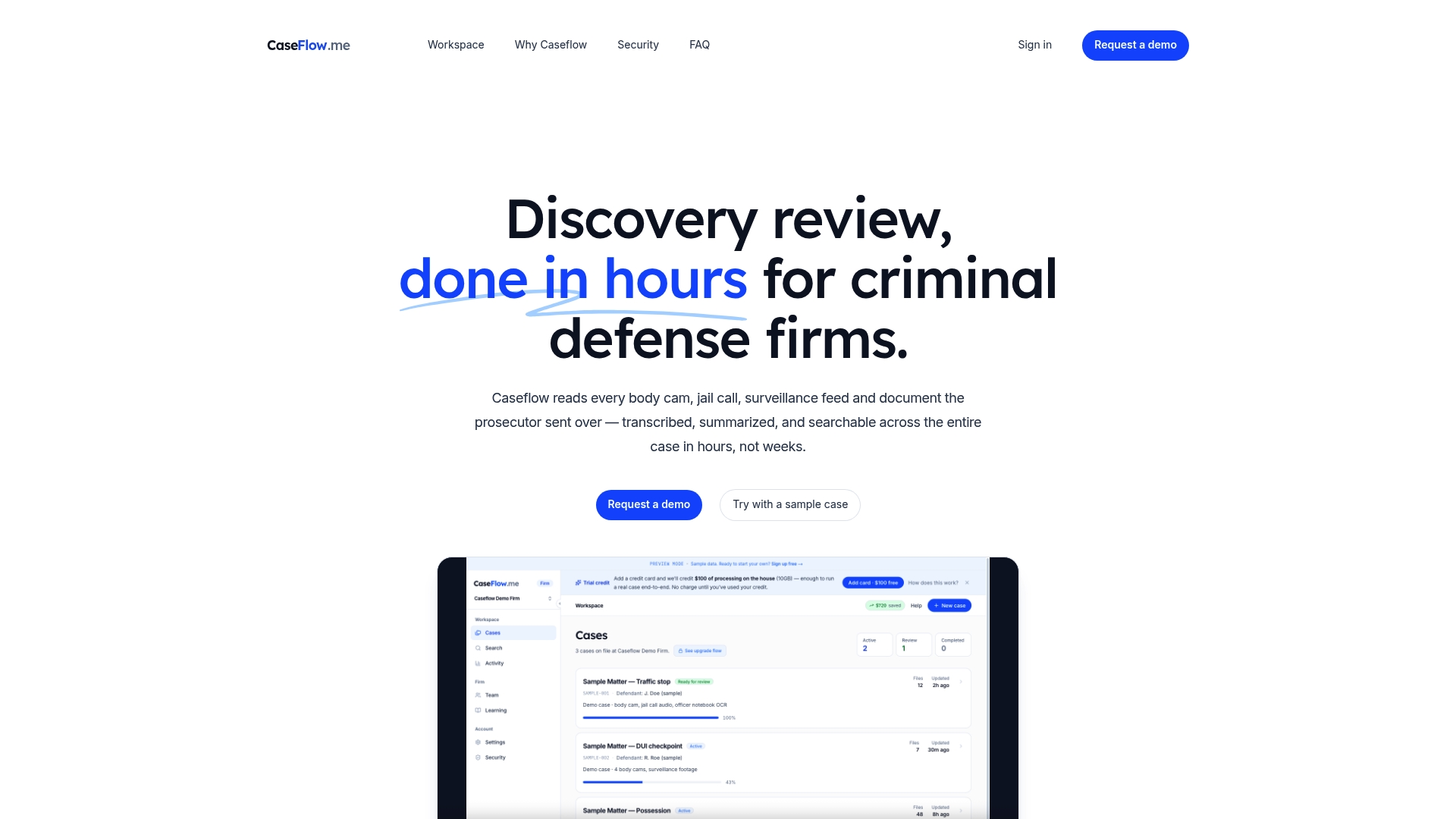
Caseflow combines transcription, summarization, and searchable entity extraction in one platform. The Brady-trail audit log records every action on every case file, satisfying compliance requirements without additional administrative work. Multi-language support preserves original audio while making evidence fully searchable. Attorneys who previously spent weeks on document review report completing the same work in hours. For firms evaluating their discovery software options, Caseflow offers a purpose-built solution for criminal defense. See what it does for your caseload at Caseflow.
FAQ
What is the role of searchable discovery tools in legal practice?
Searchable discovery tools index and retrieve case evidence through keyword and AI-powered semantic search, replacing manual document review. Their primary role is to surface critical information faster and more accurately than traditional file review methods.
How do discovery tools work with unstructured legal data?
Discovery platforms ingest documents, audio, and transcripts, then extract metadata and entities before building a searchable index. Hybrid architectures handle unstructured data by combining keyword indexing with semantic vector search for comprehensive retrieval.
What is the biggest risk of using AI semantic search in discovery?
Semantic search can suppress contradictory evidence by ranking documents that confirm the query’s direction higher than documents that challenge it. Always run a parallel keyword search to catch evidence the semantic model deprioritized.
Why does source-of-truth separation matter in legal discovery?
Keeping the original evidence database separate from the search index prevents accidental modification and preserves chain of custody. Separation of these systems also ensures the search index can be rebuilt without affecting the underlying evidence record.
What governance features should legal teams require in a discovery platform?
Legal teams need role-based access control, immutable source databases, real-time index synchronization, and a complete audit log of every user action. These features together satisfy Brady disclosure obligations and protect against spoliation claims.
Recommended
Procedural content for defense attorneys — not legal advice in your jurisdiction.
Start free trial · $100 credit