What Is Discovery Project Management? A Clear Guide
Learn what is discovery project management. Discover how this crucial phase defines goals and reduces risks in project execution.

What Is Discovery Project Management? A Clear Guide
Discovery project management is the structured upfront phase of a project lifecycle that clarifies goals, defines scope, assesses feasibility, and identifies risks before any execution begins. Think of it as the diagnostic step that separates projects that succeed from those that spiral into rework and budget overruns. The discovery phase in project management transforms a project vision into concrete inputs: requirements, milestones, dependencies, and a risk-adjusted plan. Project managers who skip this phase often pay for it later with scope creep, misaligned stakeholders, and costly late-stage changes.
What is discovery project management and what does it produce?
Discovery project management is a dedicated workstream at the start of a project that replaces assumptions with validated facts. It covers four core questions: What is the real problem? What does success look like? What are the constraints? And is this feasible? The answers feed directly into formal project planning.
The outputs of a well-run discovery phase are concrete and specific. They include:
- Project brief: A written summary of goals, scope boundaries, and success criteria agreed upon by all stakeholders
- Requirements documentation: Validated functional and technical requirements grounded in real user and business needs
- Risk register: A log of identified risks with likelihood, impact, and proposed mitigations
- Rough project plan: Early milestones, dependencies, and resource estimates based on discovery findings
- Feasibility assessment: A clear go or no-go recommendation supported by technical and business evidence
Discovery outputs such as dependency assumptions, risk registers, and delivery structures form the primary inputs to formal project plans. Without these, discovery was not properly executed. A project brief without a risk register is an incomplete deliverable, not a finished discovery.
Pro Tip: Schedule discovery as close to the start of execution as possible. Insights go stale quickly. A discovery completed three months before kickoff may no longer reflect current stakeholder priorities or technical realities.
What are the core activities in a discovery phase?
The discovery process in software typically follows five steps: team assembly, situational understanding, problem definition, in-depth research, and detailed evaluation. This structure applies equally well to non-software projects. Each step builds on the last, and skipping one creates blind spots that surface later as execution problems.

Team assembly means identifying who needs to be in the room. That includes the project sponsor, subject matter experts, technical leads, and end users. Getting the wrong people in discovery is as damaging as skipping it entirely.
Situational understanding covers the current state. What processes exist today? What systems are in place? What is working and what is broken? This step often surfaces fragmented information and system mismatches that cause execution failures when left unaddressed.
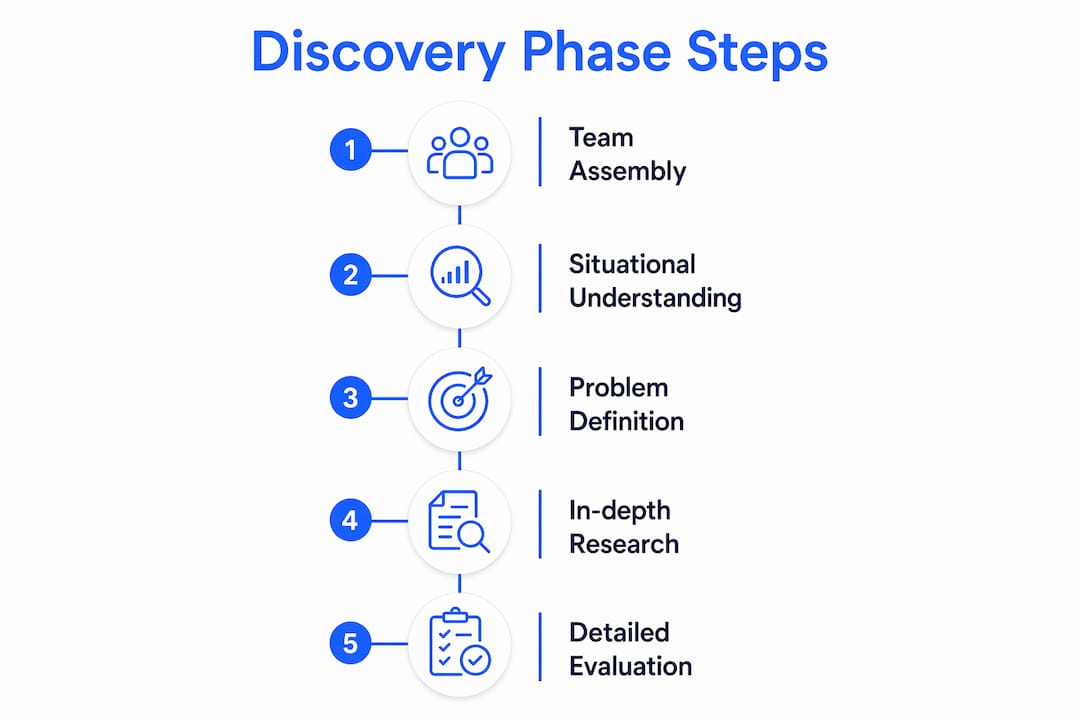
Problem definition narrows the focus. Teams document the specific gap between the current state and the desired outcome. Vague problem statements produce vague requirements, which produce vague deliverables.
In-depth research validates assumptions. This includes user interviews, data analysis, competitive benchmarking, and technical audits. A common discovery workshop brings the project team and stakeholders together to define objectives, logistics, budget, timeline, and success standards. These workshops are the engine of the discovery phase.
Detailed evaluation synthesizes findings into a feasibility recommendation and a set of prioritized requirements. This is where the team decides whether to proceed, pivot, or stop.
Why does discovery reduce project risk and cost?
Discovery represents roughly 5–10% of total project cost yet prevents problems that can consume 30–50% of budgets through scope creep and overruns. That ratio makes discovery one of the highest-return investments in any project.
The mechanism is straightforward. Discovery replaces guesswork with validated requirements. When teams skip it, they build plans on assumptions. Assumptions fail when they meet reality during execution, and fixing them mid-project costs far more than preventing them upfront.
“Discovery replaces assumptions with shared understanding across business context, technical realities, and workflows, enabling considered rather than reactive delivery decisions.” — CodeGalaxy
The specific risks that discovery mitigates include:
- Scope creep: Undefined requirements invite constant additions that stretch timelines and budgets
- Budget overruns: Unvalidated cost estimates collapse when technical complexity is higher than assumed
- Stakeholder misalignment: Undocumented expectations diverge over time, creating conflict during delivery
- Technical debt: Building on a misunderstood technical foundation creates compounding problems
Diagnosing the current technical state during discovery means requirements are validated against real constraints rather than optimistic assumptions. This integration protects both schedule and cost estimates.
Pro Tip: Run a technical assessment in parallel with requirements discovery. Separating them creates a gap where requirements get validated against business needs but not against technical reality. Both checks must happen together.
Discovery vs. scoping: what is the difference?
Discovery and scoping are related but distinct phases. Confusing them leads to skipping one or conflating their outputs, which weakens both.
| Dimension | Discovery | Scoping |
|---|---|---|
| Primary question | What is the problem and is it solvable? | How will we solve it and what will it take? |
| Timing | Before scoping | After discovery |
| Key outputs | Risk register, feasibility assessment, requirements | Project plan, budget, timeline, resource allocation |
| Stakeholders | Sponsors, users, technical leads | Project manager, delivery team, finance |
| Decision made | Go, no-go, or pivot | Commit to execution plan |
Discovery focuses on understanding the problem and validating feasibility. Scoping takes discovery outputs and builds the execution roadmap. A project that jumps to scoping without discovery is planning how to deliver something it does not yet fully understand.
Decision gates at the end of discovery, including feasibility and scope validation, significantly reduce late change requests and rework during delivery. The gate is not bureaucracy. It is the moment where the team confirms that what was discovered is worth building and that the plan to build it is grounded in reality.
How long does a discovery phase take?
Discovery duration varies by project size and complexity. Small projects typically need 1–2 weeks. Large or complex projects often require 4–6 weeks. The right answer is driven by learning needs, not by calendar pressure.
Several factors determine how long discovery should run:
- Project size: Larger projects involve more stakeholders, more systems, and more requirements to validate
- Level of uncertainty: High-innovation projects with no existing reference points need more research time
- Stakeholder availability: Discovery stalls when key decision-makers are unavailable for workshops or reviews
- Technical complexity: Projects touching legacy systems, integrations, or regulatory requirements need deeper technical audits
The most common mistake is compressing discovery to hit an arbitrary start date for execution. A two-week discovery on a project that needs six weeks produces incomplete outputs. Incomplete outputs mean the project plan is built on partial information, which is only marginally better than no discovery at all.
Pro Tip: Define the minimum viable discovery output before you start. List the specific deliverables the team needs to proceed with confidence. Stop discovery when those deliverables are complete and validated, not when the calendar says to stop.
How to conduct a discovery project effectively
Effective discovery does not happen by accident. It requires deliberate planning, the right participants, and a clear structure for turning findings into decisions.
Follow these steps to run a discovery phase that produces results:
- Define the discovery scope. Identify what questions must be answered before execution can begin. Write them down. These questions become the agenda for every workshop and interview.
- Assemble the right team. Include the project sponsor, at least one technical lead, a representative end user, and the project manager. Missing any of these creates blind spots.
- Plan and facilitate workshops. Structure each session around a specific output. A workshop without a defined deliverable produces conversation, not decisions. Use tools like Miro, Confluence, or Microsoft Teams to document findings in real time.
- Conduct stakeholder interviews. Go beyond workshops. One-on-one interviews surface concerns that stakeholders will not raise in group settings. Ask about past project failures, not just future goals.
- Perform a technical assessment. Review existing systems, data structures, integrations, and known technical debt. Requirements validated only against business needs but not technical constraints will fail during build. Understanding discovery action tracking principles can help project managers log and audit every finding systematically.
- Document and prioritize findings. Produce the risk register, requirements list, and feasibility assessment. Prioritize requirements using a method like MoSCoW (Must have, Should have, Could have, Won’t have) to give the scoping team clear direction.
- Hold a decision gate. At the end of discovery, present findings to the project sponsor and key stakeholders. The gate has three outcomes: proceed to scoping, pivot the approach, or stop the project. All three are valid. The gate prevents bad projects from consuming execution resources.
Avoid these common pitfalls: vague outputs that leave the scoping team guessing, skipping the technical assessment, and treating the decision gate as a formality rather than a real checkpoint. Project managers who want to evaluate discovery software for tracking and documenting findings will find that the right tool reduces administrative overhead and keeps all discovery artifacts in one place.
Pro Tip: Send a one-page discovery summary to all stakeholders within 48 hours of the final workshop. Delay creates memory gaps and allows misaligned interpretations to take hold before the formal deliverables are circulated.
Key Takeaways
Discovery project management is the highest-return investment in any project, converting uncertainty into validated plans before a single line of execution begins.
| Point | Details |
|---|---|
| Discovery defines the foundation | It clarifies goals, scope, feasibility, and risks before execution starts. |
| Core outputs are non-negotiable | A risk register, requirements doc, and feasibility assessment must be produced. |
| Discovery costs less than failure | Investing 5–10% of project cost in discovery prevents 30–50% budget overruns. |
| Discovery and scoping are distinct | Discovery answers what and why; scoping answers how and when. |
| Duration follows learning needs | Small projects need 1–2 weeks; complex ones need 4–6 weeks based on complexity. |
Discovery is the phase most project managers underestimate
Most project managers understand discovery in theory. Far fewer protect it in practice. When timelines get tight, discovery is the first phase to get compressed. That is exactly backwards. The less time you have, the more you need discovery to eliminate waste from execution.
The misunderstanding I see most often is treating discovery as a planning formality rather than a diagnostic process. Teams go through the motions, run a kickoff workshop, produce a slide deck, and call it done. The real work of discovery is uncomfortable. It means asking stakeholders to admit what they do not know. It means surfacing technical problems that nobody wants to acknowledge. It means recommending a pivot or a stop when the findings do not support proceeding.
The projects I have seen fail most spectacularly were not underfunded or understaffed. They were under-discovered. The team had a vision and a deadline, and they built toward both without ever validating that the vision was achievable or that the deadline was realistic. Discovery would have caught both problems in week two.
My advice is simple: treat the decision gate at the end of discovery as the most important meeting in the project. Not the kickoff. Not the launch. The gate. That is where you decide whether the project deserves execution resources. Get that decision right, and everything downstream gets easier.
— Faisal
How Caseflow supports discovery workflows for legal teams
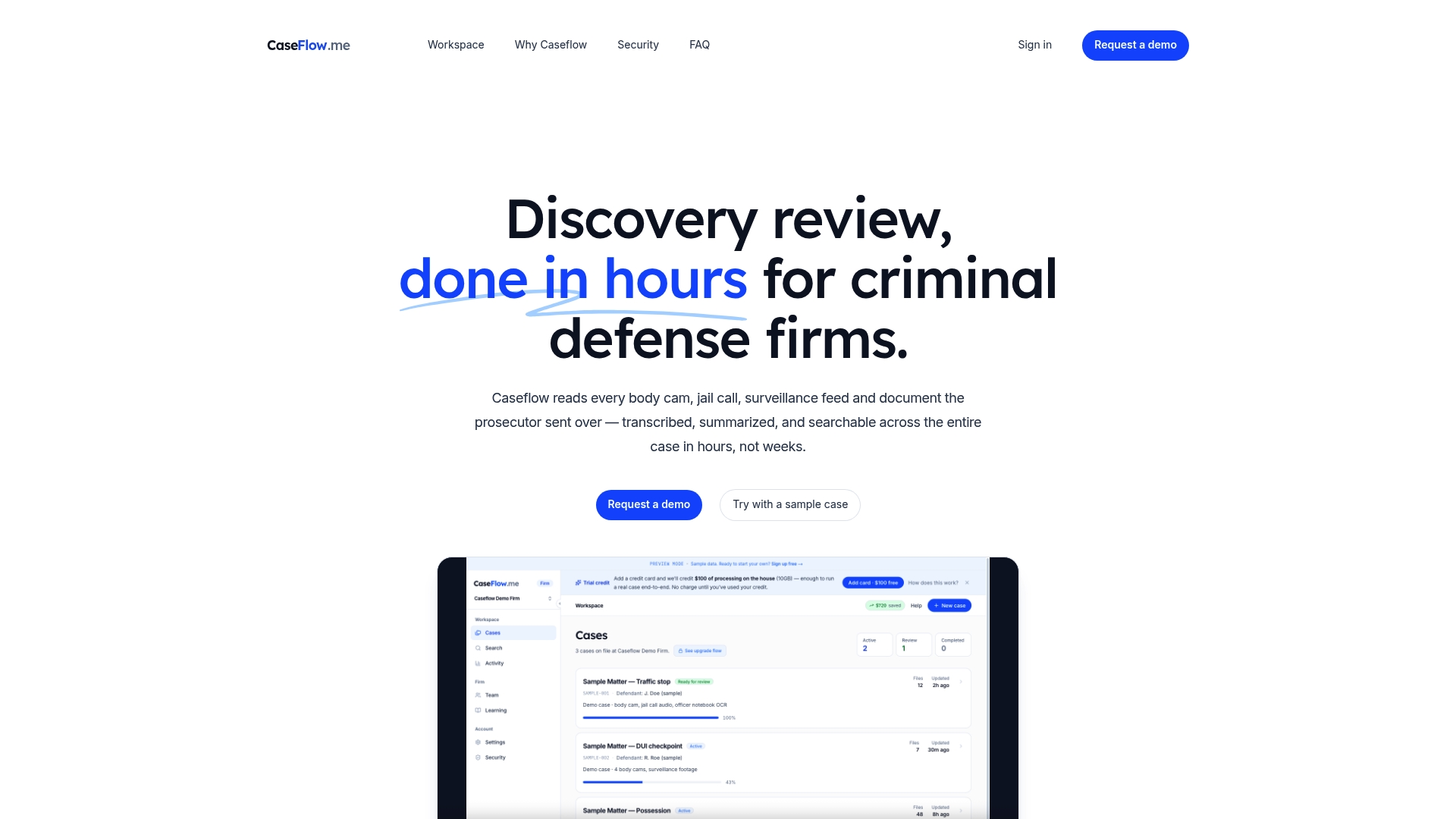
Legal discovery is one of the most document-intensive discovery processes that exists. Caseflow is built specifically for criminal defense attorneys who need to move through case files fast, without sacrificing accuracy or compliance. Traditional discovery review can take weeks. Caseflow reduces that to hours through AI-powered transcription, summarization, and searchable entity extraction, all in one platform.
The Brady-trail audit log tracks every action taken on case files, giving legal teams a transparent record that holds up to scrutiny. For teams managing high-volume discovery, Caseflow’s AI-powered platform delivers the kind of speed and accountability that manual review cannot match. If your team handles criminal defense discovery, Caseflow is worth a close look.
FAQ
What is the main goal of discovery project management?
The main goal is to replace assumptions with validated facts before execution begins. Discovery defines the problem, confirms feasibility, and produces the risk register and requirements that feed formal project planning.
How does the discovery phase differ from project planning?
Discovery answers what the project should do and whether it is feasible. Project planning answers how the team will execute it. Discovery must come first because planning built on unvalidated assumptions produces unreliable schedules and budgets.
What happens if you skip the discovery phase?
Skipping discovery means building execution plans on assumptions. Those assumptions surface as scope creep, budget overruns, and stakeholder conflicts during delivery, at a cost far higher than discovery would have required.
Who should be involved in a discovery workshop?
A discovery workshop needs the project sponsor, at least one technical lead, representative end users, and the project manager. Missing any of these roles creates gaps in requirements and feasibility assessment.
How do you know when discovery is complete?
Discovery is complete when the team has produced a validated risk register, a prioritized requirements list, and a feasibility recommendation, and when the decision gate has confirmed that the project is viable to proceed.
Recommended
Procedural content for defense attorneys — not legal advice in your jurisdiction.
Start free trial · $100 credit